My idea of home has always been very fluid, not really something I was able to define. When I think of home, I do not think of places, I think of an idea. The idea that home can be anywhere I make it, home is where I decide to settle for however long I choose to be there. I think that my computer represents that well. It is something that I can put down and use, but at a moment’s notice I am able to carry away with me, free to pursue my next destination.
I think the looping aspect of the gif, as well as the very similar nature of the two depictions of my computer play into this idea as well. A computer also represents the incorporeal, the unreal, the culmination of human science and technology, and it pleases me a little to have that as an idea of home. The two representations show that my home is a physical place, as well as somewhere that isn’t real, somewhere that exists, but does not at the same time.
This project was especially difficult for me creatively. InDesign was easy to learn and use, but I took the longest time deciding what I wanted to make this project about. I bounced from idea to idea, designing maybe one page before moving on to a different focus. This project not only taught me how to use InDesign to affectively arrange my work, but how to latch on to an idea and just make it work.
My idea of home has always been very fluid, not really something I was able to define. When I think of home, I do not think of places, I think of an idea. The idea that home can be anywhere I make it, home is where I decide to settle for however long I choose to be there. I think that my computer represents that well. It is something that I can put down and use, but at a moment’s notice I am able to carry away with me, free to pursue my next destination.
I think the looping aspect of the gif, as well as the very similar nature of the two depictions of my computer play into this idea as well. A computer also represents the incorporeal, the unreal, the culmination of human science and technology, and it pleases me a little to have that as an idea of home. The two representations show that my home is a physical place, as well as somewhere that isn’t real, somewhere that exists, but does not at the same time.
In this project I learned quite a bit about my own creative process. The skills I used were all developed through previous projects, but this assignment helped me develop my own process. Because of the way I created this gif, I was required to shoot, reshoot, edit, and reedit the same set of video multiple times to really develop the look I was attempting.
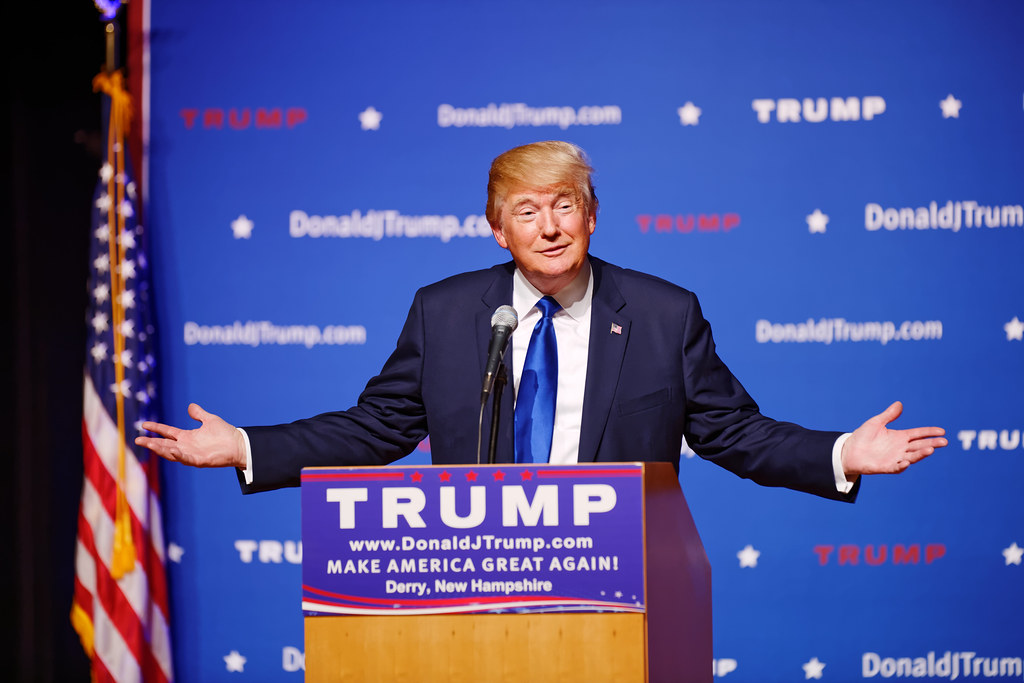
I started this project with one word on my mind: Trump. As I did some background research, mostly looking at YouTube videos, it occurred to me that the word was on man other people’s minds as well. So, I ran with it, incorporating the sensationalism of this presidency into a screenshot of the news cycle that we are in. No matter which way you turn, you hear news about Trump. I wanted to primarily focus on the suspicions of Russian interference in the 2016election, and I think that most, if not all, of the video segments I incorporated into my piece address the Russian problem in some way.
Whether any meddling actually occurred is up to the observer, but I hope this video highlights the discussion that is happening. You cannot talk about the Russian suspicions in the election without mentioning Donald Trump, perhaps because he was one of two major candidates, perhaps because he was somehow involved.
I particularly enjoyed this project because of the skills I was able to develop in Adobe Premiere. The ability to visualize ideas that pop into my head through video editing is an asset I will not underutilize in the coming years. Basic video editing and assembly, as well as sound editing are invaluable assets I developed.
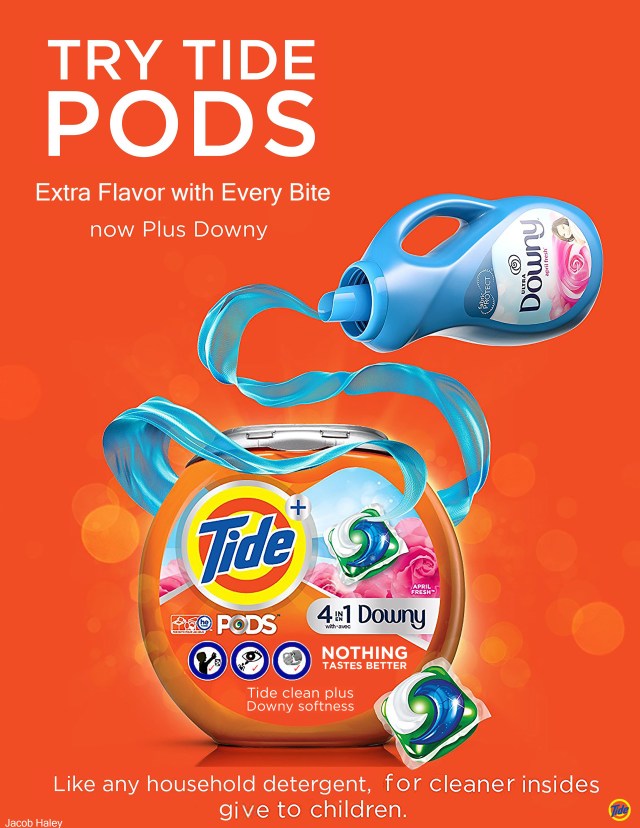
At the outset of this project I was looking for something humorous to focus my attentions on, and the timing of people eating Tide Pods could not have been better. On many television news shows, and countless articles across the internet, people are warned off from eating Tide Pods, after an alleged trend reared its head on YouTube. People putting the detergent packs in their mouths, pretending to eat the toxic material.
Personally, I have found the reporting on the event to be needlessly paternalistic and inflammatory. Most people are not confusing laundry detergent with brightly colored candies. I composed this piece to highlight that, creating my final product out of several preexisting Tide Pod advertisements, showing the ridiculousness of thinking people could be duped into thinking Tide Pods are safe to eat.
Photoshop is one skill I have always wanted to learn. With this project I was able to master the basic uses of the program as well as discover the drawbacks and advantages of using online images. Creatively, this project also helped me understand the limitations that software offer, giving me a better idea of what is possible for work in the future.
This class has been a guided process towards writing our own news feature. Other elements were covered in a good amount of detail, like the writers journey, but the largest portion of the class had to do with researching, interviewing, and writing a news feature. I have furthered my skills in deep research, and learned essential interviewing techniques, the kabob format for news, as well as the cyclical nature of stories, and screen play formats.
The news feature was a long, drawn out process, that gave an in depth look at the writing process, but was not representative of an actual assignment/deadline for a news room. We drafted a proposal to present to the class, to get feedback and comments. We started by finding sources and potential interviews. We spent time breaking down the reasons all of those sources would be beneficial, and we developed the correct questions to ask our specific sources. From there we carried out our interviews, and pulled the relevant information from our sources and recordings. From there it was a comparatively simple matter of pulling it all together, to publish the news feature on our blogs.
My screenplay had less time and more deadline. It is a rushed job, although I hope the ideas and base elements behind it are strong. I started with an idea in my head and unwound, seeing where it would take me. I consulted the writers journey from there, to limit it to the first act, and provide a narrative backbone, and just got to writing. I didn’t have any specific writing process, other than typing what came into my head.
Overall, the thing that piqued my interest most in this class was the variety of people. It seemed that everyone in the class was interested in different fields, but NMC all just happened to bring them together, but I guess that is just college.
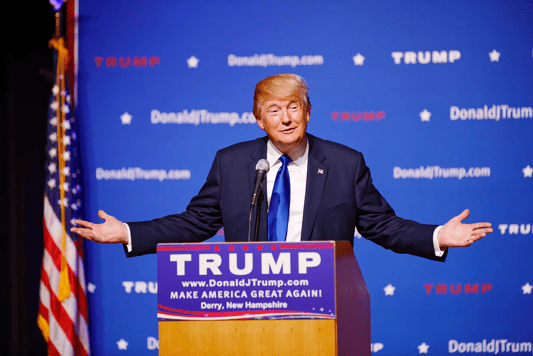
In 2016, a new President of the United States was elected into office. Donald Trump formally announced his candidacy in 2015 for that office, and proceeded to launch an aggressive and very effective social media campaign, with a heavy focus on the micro-blogging platform, Twitter. Much to the surprise of some, and the obvious expectancy of his loyal base, he won. The question is, how was he able to circumvent such established mediums that dominated the news sector for so long, and launch himself to the highest office of the United States, amongst an almost overwhelming amount dirt surrounding him.
Twitter has become a large-scale broadcasting platform, incorporating news, and politics, into what was once just a small social networking site. People are now able to send out breaking news updates in the blink of an eye, leaving the roadblocks that previously afflicted print media behind, and other electronic blogging platforms in the dust. Twitter has been an integral part of many different social movements including: the Arab Spring, march on wall street, and most recently, the 2016 election. Twitter has become a way to broadcast a message, and gather free media attention, but in spite of all this, some doubt its viability for the future.
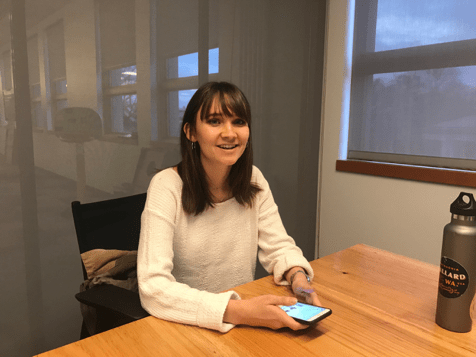
Kaitlyn Swinford discussing OMN
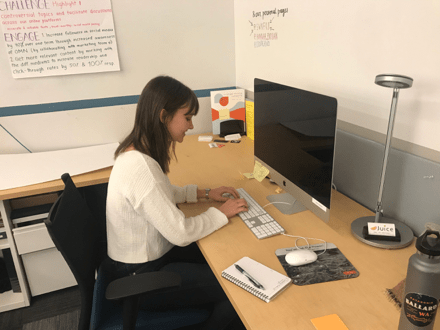
At Oregon State University, a largely student run news organization is integrating traditional journalism practices more commonly associated with print news and social media strategies. At the Orange Media Network, a collection of all of Oregon State’s news and entertainment mediums, social presence is crucial. Kaitlyn Swinford, the social media manager for OMN, coordinates with the individual managers of each platform the OMN offers (KBVR FM, KBVR TV, Barometer,Prism,Beaver’s Digest,DamChic), to produce content uniquely across social media sites.
Kaitlyn Swinford working at her computer
“I look at the Twitter platform for all our mediums, and all of them use it pretty uniquely. So, like the Baro, for example, is like constantly tweeting, there’s constantly new stories coming out, because they are a daily… But, like for DamChic, for example, they’re not very active, they mostly promote themselves, if they have any events, or like they have an article that week, or they’re highlighting costume design or things like that.”
Finn John is a New Media Communications professor at Oregon State University. He has worked as a journalist for a newspaper in the past, before moving onto the magazine industry, and eventually ending up teaching at the university, and running his own publishing house for audiobooks in the public domain. Finn John teaches a variety of classes at Oregon State, among them NMC 499, Spin Detecting, a class aimed at seeing the bias in media.
According to John, social media, “when you drill right down to its core, is a whole community of broadcasting stations, big ones and little ones, all sending messages out into the world. Fundamentally, you are doing the same thing with your Twitter account that Fox News is doing from its broadcast studios; the differences are merely scale and format. So, traditional media have had to find their place in a new world in which anyone can do what they are doing.”
This doesn’t mean news organization are obsolete, however. John went on to say: “people are looking at a piece of news and going, ‘What’s Worldnewsdailyreport dot com? Can I trust them?’ before getting mad and sharing it. Which is a good thing – for everyone. And it means that suddenly the thing that traditional media are good at – generating original, trustworthy copy – is much more in demand by people who want to share it with their friends.”
Hannah Loh, Kaitlyn Swinford’s coworker at OMN, and the web and mobile manager, believes their weekly news publication (which posts all of their content online), the Barometer, does a good job of relating national level politics to the everyday lives of students. Hannah works with her team to track analytics of the articles, and social media blasts that accompany them, to better produce content that will reach their intended audience. While Hannah believes in the power of social media, and the ease of communication it offers, she does it admit it can be lacking.
“I feel like for magazines having that physical copy kind of like gives students something to take back and actually see and hold in your hand, so it’s a little bit different. Whereas on social media you just like reading through it and you’re exiting, but with a physical copy you’re able to keep it. It’s weird, its aesthetically pleasing, too.”
Finn John thinks the way social media is utilized gives power to people. It removes the gatekeepers of traditional media, and puts the people in direct contact with the message: “…the authorities can inject commentary into the conversation directly, in a way they didn’t used to be able to do. In the long run this will probably keep both them, and the fast-and-loose edge of the media (big city tabloids, talking heads, etc.) more honest.” Finn thinks this is good on a whole, but has had ill effects for Donald Trump. His opinion is not shared by all, however.
Donald Trump used Twitter as a campaign has never used it before. He was able to poll himself on many different topics: jailing Clinton, climate change denial, and use that data to measure the reaction of his base. He could mold his seemingly random jabs and attacks to better resonate with his potential voters (Source). Some believe that this is campaigning of the future, and some believe he has done himself real damage politically, but Daniel Faltesek disagrees with both ideas.
Dan is also a professor at Oregon State, also in New Media Communications, and he recently scraped Twitter data for the 2016 presidential election. Starting the project in July of 2015, Dan gathered data by creating a fake Twitter application that was able to plug data into a piece of software, RStudio, that he can then use to run statistical analysis. He also used a third party to provide a backup. He has not yet used the data for any particular purpose, but he is able to draw preliminary conclusions, and provides intermittent updates on his website. (Source)
Dan thinks that this election was a complete fluke; “Do not expect 2016 to set a precedent for anything.” What I would say about presidential elections in general is: they’re all special.” For some elections, the key issue can be as ridiculous as a potential vice president saying it is alright to live in an apartment your whole life, or the president seems like a cool, saxophone player, but for Trump, it was the incredible media coverage he received.
A study conducted by two members of the University of Minnesota in 2013, found that “the sheer number of tweets sent by a candidate had no effect on the election results… but the number of followers a candidate had significantly increased their odds of winning the election.” The study went on to explain that it is much better to engage voters, rather than simply inform them. This highlights Donald Trump’s strategy of attention grabbing tweets; the more attention garnered, the more he gets talked about (Source).
Trump’s tweets might seem outlandish, and very provocative at times, but for him that is only for the better. Dan Faltesek explains, “Any coverage can be good to build awareness unless it’s the kind of thing that actually breaks the underlying structure of your celebrity identity. And what I mean by that is most celebrity identities are built on the equilibrium that they are able to disavow challenges they hold themselves together they are made coherent through lots of different discourses.”
Dan thinks this is why it is so difficult to hold Donald accountable for his messages and actions on Twitter, because “Donald Trump’s whole thing is that he’s powerful, and can’t be stopped, that he’s insatiable in some ways. And so, you can accuse him of abuse of power all day and that doesn’t matter, because his celebrity identity is premised on the idea that he will abuse power.” This idea, in addition to his expert use of social media to garner free media coverage, allowed him to pull ahead of what Dan calls an overconfident Clinton campaign. His actions leading up to his elections as president do not set a precedent, because they could literally only work for him in the exact situation he found himself in.
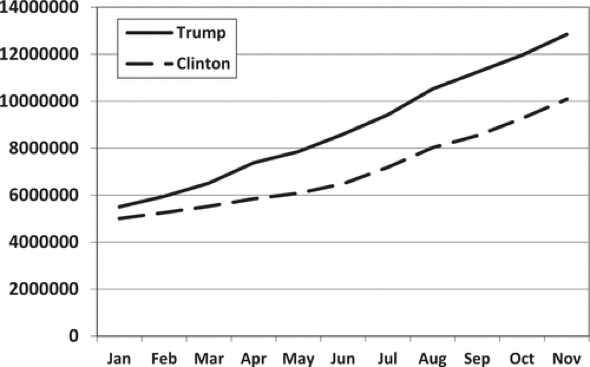
Trump’s Twitter followers slowly outpaced Clinton as election day approached on November 8th, 2016. He not only beat her on Twitter, but he was the most googled candidate and had the most mentions on Facebook of any candidate for the election. He just had more buzz on social media.
The free media coverage he received was another contribution to his success. Tweets, especially as Trump makes them, are finding their way into more traditional journalism more and more. Stories are now peppered with tweets to add variety and interest, and Trump is fantastic at getting his tweets picked up, and covered for free. It is estimated that Trump was able to raise “the equivalent of $402 in free attention… as compared to $166 million for Clinton.” This is only a third of Clinton’s overall campaign contributions of 1.2 billion, but that is entirely free marketing that adds to his overall funds raised of $647 million. Trump was able to utilize his personal style of Tweeting to almost match the contributions of his opponent (Source).
Twitter has been around since 2006, and the way people interact with social media has changed drastically in that short amount of time. In light of a very divisive presidential election, the nagging fear of fake news, Dan Faltesek believes the change has not stopped. “I think people are more and more suspicious of social media. I think that people post a lot less than they used to. I think that many platforms like snapchat are busy dying. And people don’t enjoy Twitter, they don’t go on Twitter.”
To Dan, the end of Twitter is nigh: “I don’t I do not think Twitter is going to recover. I think it’s too toxic. I think they had their hand off the rudder for way too long.” He compares Twitter and Reddit, another social media platform where users can post to boards (subreddits) and other users upvote or downvote the submissions. Twitter has become a haven for trolls and bots, and Twitter will hardly move a finger to intervene, in the pursuit of free speech. The user base for Twitter is gaining, but at a steadily decreasing rate. Reddit, on the other hand, has “been really aggressive in recent years about pruning out bad actors. As they have done this, activity on Reddit increases. When you get rid of the horrible trolls they don’t move (switch accounts). Their internal studies suggest that the trolls don’t move to another board, that they just stay gone.”
Moderation can seem scary to some, but as Dan points out “It is very likely that the person you were having an argument with in the comments is a robot.” Free speech doesn’t matter if the only conversations are between robots and trolls. Activity on Reddit is increasing, and “Reddit is having trouble selling all the advertising because so many people want to buy.” Dan thinks Reddit may have found what Twitter is missing: “Reddit is fun. You know, it is enjoyable. Twitter is not fun. Twitter is just a world of pain. And why should anyone have to use that?”
Whether it is made to last or not, Twitter has been an important part in society for the past decade. Should another social media platform succeed it, it will always be remembered for the good, and the bad, that emerged because of it. It was one of the first platforms to allow people real access to authority figures almost every single second of the day. Before Twitter reached the prominence it did, often the best you could possibly hope for was a 24 hour response. Maybe that is actually preferable in some cases, cooler heads do prevail, but it provided an outlet to the voiceless, who had never before had the opportunity it gave them.


 Jacob Haley